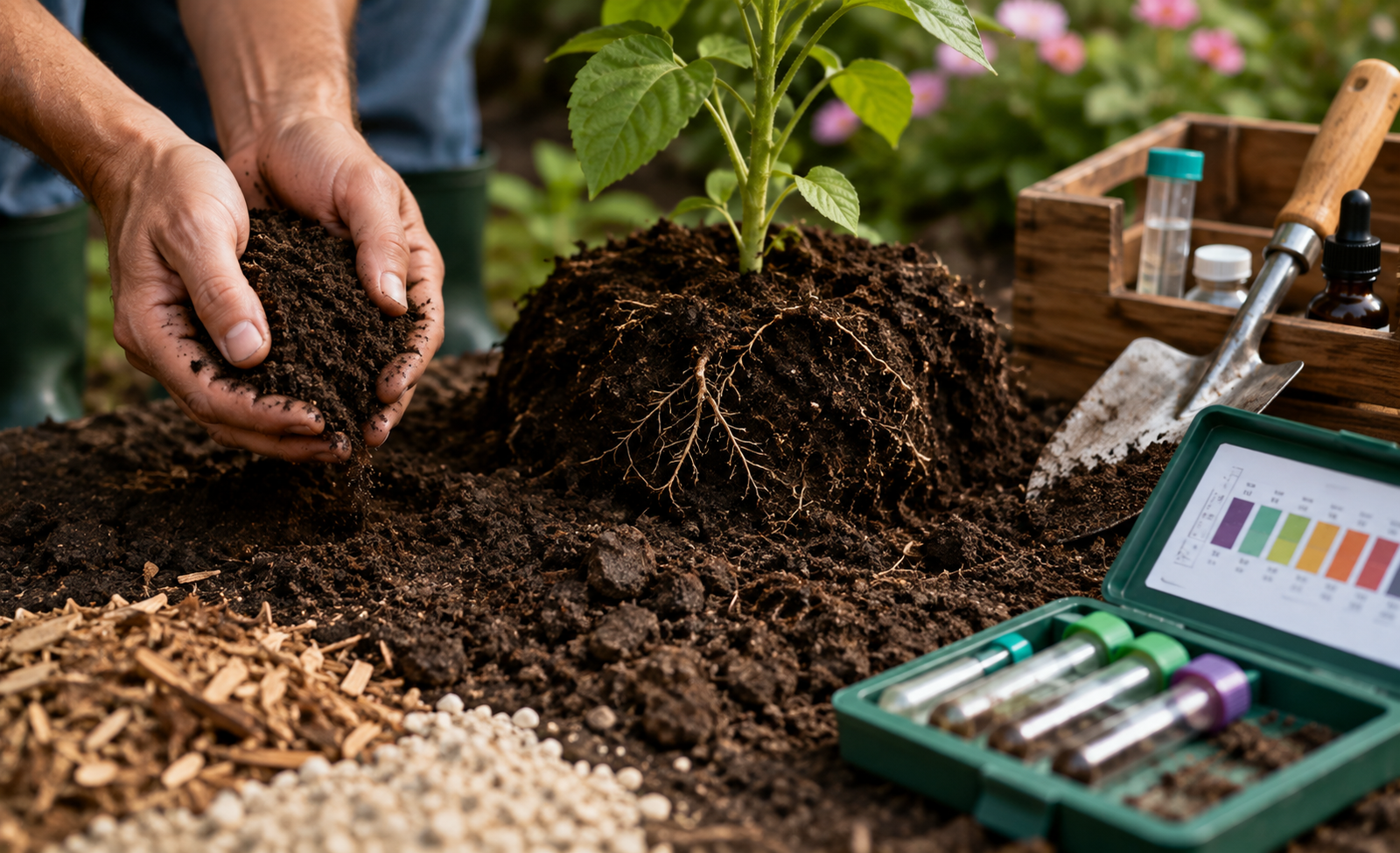
It’s tempting to diagnose a struggling garden by looking at what’s visible above the soil line — yellowing leaves, stunted growth, poor yields. But a huge share of common garden problems actually trace back to something invisible: the soil itself. Plants that consistently underperform despite adequate water and sunlight are very often dealing with a soil issue that no amount of surface-level troubleshooting will fix.
This guide breaks down why soil health deserves far more attention than most home gardeners give it, and how to approach testing and improving it without needing a lab degree to make sense of the results.
Why Guessing About Soil Rarely Works
It’s easy to assume soil is “probably fine” simply because plants are growing at all, but marginal soil can support plant life while still holding plants back significantly from their real potential. Nutrient deficiencies, improper pH, and poor drainage often produce symptoms that look similar to other problems — pests, underwatering, insufficient light — which leads a lot of gardeners to troubleshoot the wrong issue entirely.
This is exactly why testing beats guessing. A soil test replaces assumption with actual data, which means the fixes that follow are targeted at the real problem instead of a plausible-sounding guess.
What a Basic Soil Test Actually Tells You
A standard home soil test typically covers a handful of key measurements that explain most common garden struggles:
- pH level, which determines how available nutrients are to plant roots regardless of how much fertilizer is applied
- Major nutrient levels — nitrogen, phosphorus, and potassium — the primary building blocks for healthy plant growth
- Organic matter content, which affects water retention, drainage, and the soil’s ability to support beneficial microbial activity
- Soil texture, whether it leans sandy, clay-heavy, or loamy, which shapes how water and nutrients move through it
Understanding these basics turns an abstract concept like “healthy soil” into something concrete and actionable, rather than a vague goal with no clear starting point.
DIY Testing vs. Lab Testing: What’s Actually Worth It
Home soil test kits offer a reasonable starting point for basic pH and major nutrient readings, and they’re a low-cost way to catch obvious imbalances. That said, they tend to be less precise than a lab test, particularly for micronutrient levels and more nuanced soil composition details.
For most home gardeners, a hybrid approach works well: use an inexpensive home kit for a general baseline, then send a sample to a local extension office or soil lab if results seem unusual or if a particular bed continues to underperform despite reasonable care. A detailed walkthrough of soil testing methods and how to interpret results covers both approaches in more depth, including how to properly collect a representative sample, which matters more than people often realize for getting an accurate reading.
Reading and Actually Using Your Results
A soil test is only useful if the results translate into a clear next step, and this is where a lot of gardeners get stuck. A few general patterns help make sense of common results:
- Low pH (acidic soil) typically benefits from an application of garden lime to raise it toward a more neutral range
- High pH (alkaline soil) often benefits from sulfur or organic matter amendments to gradually lower it
- Low nitrogen shows up as pale, slow-growing plants and generally responds well to compost or a balanced fertilizer
- Low organic matter affects nearly everything else and is almost always improved by regular compost incorporation, regardless of other specific deficiencies
It’s worth noting that most soil improvements happen gradually rather than overnight — amendments need time to fully integrate and affect plant-available nutrient levels, so results are typically more visible over a full growing season than immediately after application.
Compost: The Single Most Useful Soil Improvement
If there’s one universally recommended soil improvement across nearly every gardening philosophy, it’s regular compost incorporation. Compost improves soil structure, increases water retention in sandy soils, improves drainage in clay-heavy soils, and feeds the beneficial microbial life that keeps a garden ecosystem functioning well — all without the risk of over-application that comes with concentrated synthetic fertilizers.
Working a layer of compost into garden beds each season, whether homemade or purchased, tends to produce more consistent long-term soil improvement than almost any single targeted amendment, simply because it addresses structure and biology rather than just one nutrient in isolation.
Fixing Drainage Issues Without Starting Over
Poor drainage is one of the more frustrating soil issues, since it can cause both waterlogged roots during heavy rain and quick drying out between waterings, depending on the specific soil composition. Rather than replacing soil entirely, a few targeted approaches tend to help:
- Incorporating organic matter (compost, aged manure) to improve structure in both overly sandy and overly clay-heavy soils
- Raised beds or mounded rows for areas with persistent drainage problems that resist amendment
- Reducing soil compaction through minimal foot traffic on garden beds and occasional light aeration
Drainage issues, like most soil problems, tend to respond better to gradual structural improvement than to a single quick fix.
Building a Realistic Soil Improvement Routine
Soil health isn’t a one-time project — it benefits from an ongoing, seasonal approach rather than a single intensive overhaul. A practical routine might include testing once a year (ideally at the same time each season for consistent comparison), adding compost at the start of each growing season, and reassessing specific problem areas as issues come up rather than waiting for an annual check-in to address something urgent.
For gardeners just getting started with this kind of routine, this complete guide to testing and improving garden soil offers a practical starting framework, including a season-by-season approach that’s easier to follow than trying to fix everything in a single pass.
Common Soil Mistakes Worth Avoiding
A few patterns show up repeatedly among gardeners struggling with soil health, even with generally good gardening instincts:
- Skipping testing entirely and guessing at amendments, which often leads to over-application of unnecessary fertilizer.
- Expecting immediate results from soil amendments, when most changes take a full season or longer to fully show their effect.
- Ignoring organic matter in favor of only addressing specific nutrient deficiencies, missing the broader structural benefits compost provides.
- Over-fertilizing in an attempt to fix a problem faster, which can create new imbalances rather than solving the original issue.
Frequently Asked Questions
How often should I test my garden soil? Once a year is generally sufficient for most home gardens, ideally at a consistent time of year so results are comparable season to season.
Is a home soil test kit accurate enough, or do I need a lab test? Home kits work well for a general baseline on pH and major nutrients, but a lab test offers more precision, particularly for micronutrients, and is worth considering if a bed continues underperforming despite reasonable care.
How long does it take to see results after amending soil? Most soil amendments take a full growing season or longer to fully integrate and show a clear effect on plant health, so patience matters more than people often expect.
What’s the single most impactful thing I can do for garden soil? Regular compost incorporation tends to offer the broadest benefit, improving structure, drainage, and nutrient availability simultaneously rather than addressing just one isolated issue.
Final Thought
Soil health is easy to overlook because it’s invisible, but it’s often the actual root cause behind a struggling garden. Testing before amending, prioritizing organic matter, and treating soil improvement as an ongoing seasonal habit rather than a one-time fix will do more for plant health than almost any above-ground troubleshooting alone.
Also Read: Why Your Cleaning Routine Keeps Falling Apart (and How to Actually Fix It)