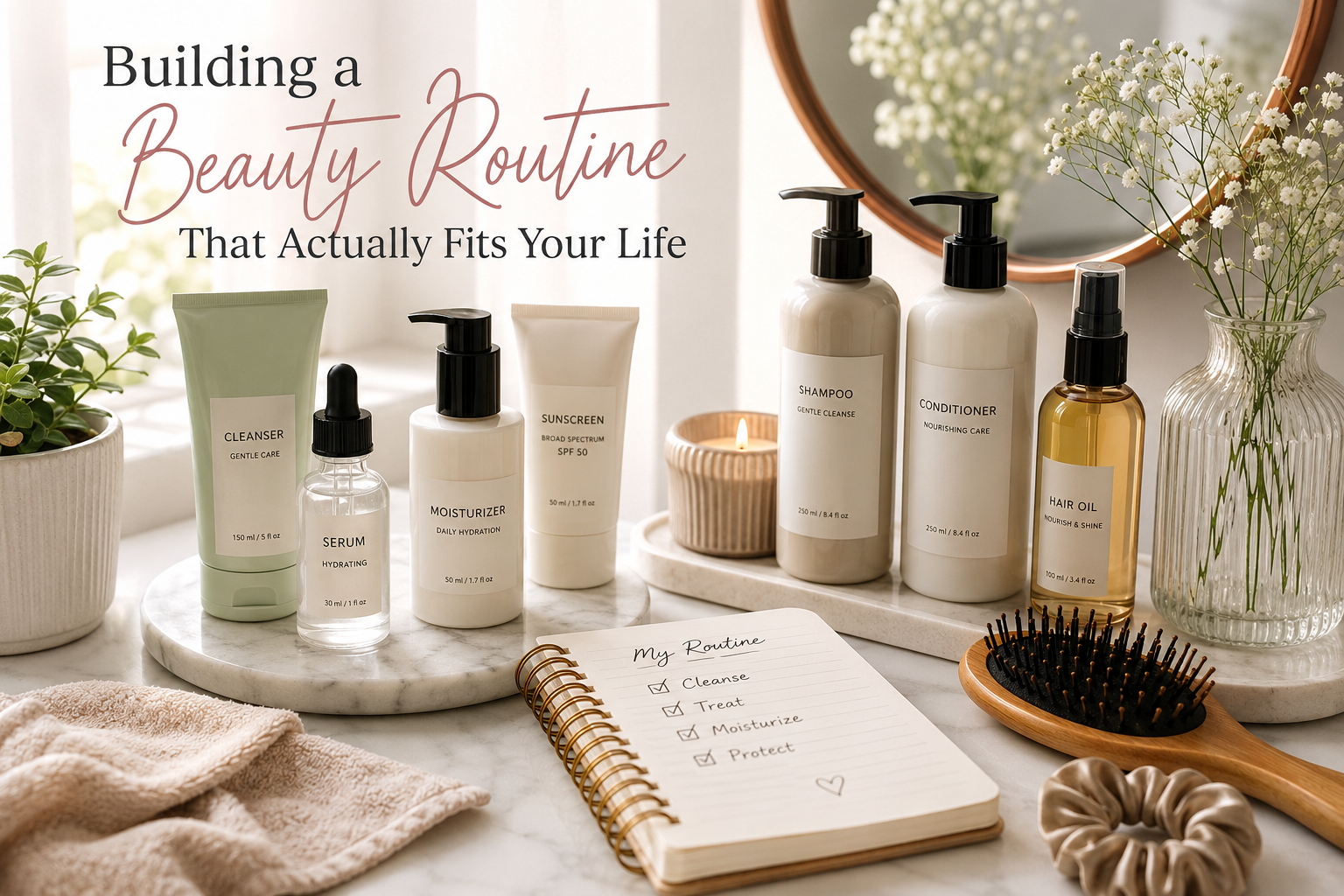
A good beauty routine isn’t the one with the most steps or the most expensive products — it’s the one you can realistically keep up with. Most people don’t struggle with beauty because they lack information; they struggle because they’ve picked up a patchwork of tips from different sources that were never designed to work together. The result is a routine that feels like a chore instead of something that actually supports healthy skin and hair over time.
This guide breaks down how to think about a beauty routine from the ground up, so what you’re doing each day makes sense together, rather than being a random collection of steps.
Start With What Your Skin and Hair Actually Need
Before adding any product, it helps to get clear on the basics: skin type, any specific concerns (dryness, sensitivity, breakouts, dullness), and how much time you realistically have each day. A ten-step evening routine sounds appealing in theory, but if it consistently gets skipped after a long day, a simpler three-step version that actually gets used will do more for your skin over time.
The same logic applies to hair care. A routine built around your actual hair type and texture — rather than trends built for a different hair type entirely — tends to produce far better results than chasing whatever’s currently popular.
A quick way to reset if your routine feels overwhelming: strip it back to the essentials (cleanser, moisturizer, sun protection) for a week or two, then reintroduce additional steps one at a time. This makes it much easier to tell what’s actually helping versus what’s just adding time to your day without a clear benefit.
Consistency Beats Complexity
One of the most consistent findings across skincare and haircare advice is that consistency matters more than having an elaborate routine. A simple routine followed daily will almost always outperform a complex one used sporadically. This is especially true for things like sun protection, gentle cleansing, and hydration, where the benefit comes from steady, repeated use rather than any single application.
If a routine feels like too much to maintain, that’s usually a sign to simplify rather than push through. A routine you’ll actually stick with is inherently more effective than an ideal one that gets abandoned after a few weeks.
Layering Products in the Right Order
A common source of frustration is applying great products in a way that undercuts their effectiveness. As a general rule, skincare works best applied from thinnest to thickest consistency — cleanser, then any treatment products, then moisturizer, then sunscreen during the day. Applying a heavy cream before a lighter treatment, for instance, can prevent that treatment from absorbing properly.
For hair, a similar logic applies: lighter leave-in treatments generally go on before heavier styling products, and heat protectant should always go on before any hot tool use, not layered on top of styling products afterward.
If you want Read more Fashion related article Visit: STYLE BLOOMING
Don’t Underestimate the Basics
It’s easy to get pulled toward trending products and skip past the fundamentals, but a few basics do more heavy lifting than most specialty products:
- Sun protection, used consistently, is one of the most impactful things you can do for long-term skin health and appearance.
- Gentle, non-stripping cleansing keeps skin’s natural barrier intact, which affects how well every other product performs.
- Adequate hydration, both from skincare products and overall water intake, supports skin that looks and feels healthier.
- Regular trims, even when growing hair out, prevent split ends from traveling further up the hair shaft and affecting overall hair health.
These fundamentals aren’t glamorous, but they tend to produce more visible, lasting improvement than chasing whatever’s trending that month.
Adjusting Your Routine Seasonally
Skin and hair needs shift with the seasons, and a routine that works well in summer often needs small adjustments come winter. Warmer months typically call for lighter moisturizers and a stronger emphasis on sun protection, while cooler, drier months often benefit from richer, more hydrating formulas and gentler cleansers to avoid stripping already-drier skin.
Hair follows a similar pattern — humidity in warmer months may call for lightweight, frizz-controlling products, while drier winter air often benefits from deeper conditioning and added moisture. Rather than overhauling a routine each season, small swaps (a richer moisturizer, an extra conditioning treatment) usually cover the shift without needing an entirely new product lineup.
Building Routines Around Your Actual Schedule
A realistic beauty routine accounts for the fact that some days simply move faster than others. Having a “full” version of your routine for unhurried days and a shortened, essentials-only version for busier ones means the routine bends around your schedule instead of getting skipped entirely on hectic days.
A simple way to structure this:
- Core steps that happen every single day regardless of time (cleanser, moisturizer, sun protection).
- Regular additions that happen most days but can be skipped occasionally without major impact (targeted treatments, styling products).
- Weekly extras that add extra care without needing daily commitment (masks, deeper conditioning treatments, exfoliation).
This tiered approach keeps the essentials protected even on the busiest days, while still leaving room for more involved care when time allows.
Frequently Asked Questions
How long does it take to see results from a new routine?
Skincare changes typically take several weeks of consistent use before visible results appear, since skin cell turnover happens gradually. Judging a new product or routine too early is one of the most common reasons people switch products before giving them a fair chance.
Is a simple routine really enough, or do more steps produce better results?
A simple, consistent routine focused on the fundamentals often outperforms a complex one, especially if the complexity leads to inconsistent use. More steps only help if they’re all genuinely needed and consistently applied.
How often should a routine actually change?
Beyond small seasonal adjustments, a routine doesn’t need to change often if it’s working. Constantly switching products can actually make it harder to tell what’s helping, since skin and hair need time to show a stable response.
What’s the most overlooked step in most routines?
Sun protection is one of the most consistently underused steps, despite being one of the most impactful for long-term skin health, regardless of skin type or concern.
Final Thought
A beauty routine doesn’t need to be complicated to be effective — it needs to be consistent, suited to your actual skin and hair needs, and realistic for your day-to-day schedule. Getting those fundamentals right tends to matter far more than any single trending product.
For more detailed, step-by-step routines and product guidance across different skin and hair needs, Style Blooming’s beauty tips and routines guide breaks down complete routines suited to different concerns and schedules.
Also Visit: Bunbin